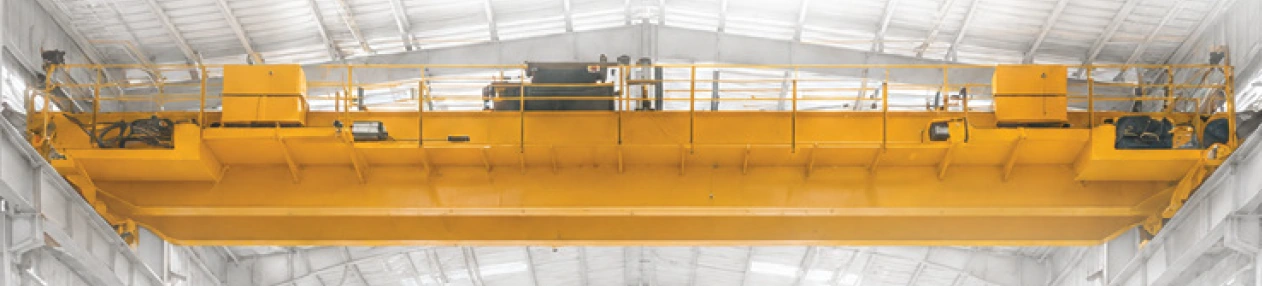
Engineered double girder eot crane for heavier overhead lifting across wider spans or higher duty cycles, configured around the load, site interface and operating duty.
Shrusti Double Girder EOT Crane is an engineered overhead lifting system for heavier overhead lifting across wider spans or higher duty cycles. It is best suited to industrial bays requiring greater hook approach, capacity or service intensity. The final configuration is not selected from a fixed SKU; it is defined around the actual load, operating route, duty cycle and site interface. During the engineering review, Shrusti confirms load weight and geometry, required movement path, building steel and runway information, bay width, then develops the arrangement, controls, guarding and installation scope around the approved application. Options such as span and lift height, hoist and reeving arrangement, single or dual travel speeds can be incorporated where technically appropriate. Final capacity, dimensions, power and performance parameters are issued through the quotation and approved drawing package.
Key features
Double-girder bridge
Higher-duty hoist and travel arrangement
Improved hook-height potential
Runway and building interface engineered to site
Application-specific engineering and layout review
Safety and access provisions defined before manufacture
Installation and commissioning support available
AMC and spares support can be included in the project scope
Operational benefits
Right-fit configuration for heavier overhead lifting across wider spans or higher duty cycles
Heavy-duty overhead runway system aligned to the available site interface
Provides full or defined bay coverage
Keeps lifting equipment above the working floor
Can serve repeated production and maintenance routes
Supports engineered duty and control selection
Technical specification framework
Indicative engineering ranges for early evaluation.
Double Girder EOT Crane indicative technical range
System type
Double Girder EOT Crane
Drive / operation
Electric hoist and powered travel
Installation / mounting
Heavy-duty overhead runway system
Configuration status
Engineered to order — indicative engineering range published
Safe working load
5–100 t
Span
10–40 m
Lift height
10–30 m
Hoist type
Electric wire-rope or chain hoist with fail-safe brake
Cross travel
5–25 m/min
Long travel
10–40 m/min
Duty class
M4–M7
Control type
Pendant or radio remote; cabin control optional on heavy-duty systems
Power supply
415 V AC, 3-phase, 50 Hz
Runway / building support
Heavy-duty building-supported runway over 10–40 m spans
Hook path
Full-bay coverage with top-running crab and approximately 0.5–2.5 m end approaches
Safety devices
Overload limiter, upper/lower limits, emergency stop, end stops, buffers and audible/visual warning options
Specification basis
Indicative engineering range for early evaluation; final rating is confirmed in the Shrusti technical offer and approved drawing
RFQ inputs required
Share the inputs that determine the design.
Required project information
Load weight and geometry
Required movement path
Building steel and runway information
Bay width
Available headroom
Required lift height
Duty cycles and operating environment
Buying guide
Start with the heaviest load, its dimensions and the required movement or coverage for the Double Girder EOT Crane.
Confirm the site interface: building steel and runway information, bay width and available power or structure.
Review operating frequency, operator workflow and safety-zone requirements before selecting the drive and controls.
Compare against Single Girder EOT Crane where the mounting, duty or coverage requirement may favour a different arrangement.
Use the quotation and approved drawing as the final technical basis; do not procure civil or structural work from preliminary dimensions.
Applications and industries
Engineered for the task and the site.
Applications
Heavier overhead lifting across wider spans or higher duty cycles
Production-bay material movement
Machine loading and unloading
Heavy maintenance lifting
Fabrication and assembly
Stores and process-area handling
Industries
Manufacturing and engineering
Automotive
Steel and fabrication
Process industries
Heavy maintenance facilities
Safety and site readiness
Review the interfaces before manufacture.
Safety and readiness notes
Runway and building support must be structurally verified.
Safe working load, duty class and hook path are established before equipment selection.
Limit switches, brakes, buffers, emergency controls and access provisions form part of the approved scope.
Installation and load testing are planned around site access and production constraints.
Customization options
Span and lift height
Hoist and reeving arrangement
Single or dual travel speeds
Pendant, radio or cabin controls
Runway and electrification interface
Maintenance access and platform requirements
Indoor or outdoor finish
Comparison
Compare nearby variants.
Variant
Drive
Mounting
Primary application
Single Girder EOT Crane
Electric hoist and powered travel
Overhead runway system
Light-to-medium overhead bay movement
Double Girder EOT Crane
Electric hoist and powered travel
Heavy-duty overhead runway system
Heavier overhead lifting across wider spans or higher duty cycles
FAQs
Questions to resolve before quotation.
How is the Double Girder EOT Crane sized?
The Double Girder EOT Crane is sized from the actual load, required movement or coverage, duty cycle and site interface. Final capacity and dimensions are confirmed after Shrusti reviews load weight and geometry, required movement path, building steel and runway information, bay width.
Is a site survey required for the Double Girder EOT Crane?
Required. A survey or engineer review is used to verify dimensions, support conditions, access, power, operating clearances and installation constraints before the final quotation.
What technical information is needed to quote the Double Girder EOT Crane?
Share load weight and geometry, required movement path, building steel and runway information, bay width, available headroom, required lift height. Layouts, photographs and existing drawings help the engineering team produce a more accurate initial proposal.
Can the Double Girder EOT Crane be customised?
Yes. The scope can be configured around span and lift height, hoist and reeving arrangement, single or dual travel speeds, pendant, radio or cabin controls, runway and electrification interface, subject to engineering review and the approved drawing.
What safety provisions apply to the Double Girder EOT Crane?
Safety provisions are selected for the application and may include guarding, access control, limits, emergency controls, restraints or structural checks. The final list is stated in the technical offer and approved scope.
Does Shrusti handle installation and support for the Double Girder EOT Crane?
Yes. The quotation can include installation, testing, commissioning, operator handover, AMC and spares support where these services are required for the project.
What is a Double Girder EOT Crane used for?
Shrusti Double Girder EOT Crane is an engineered system used for heavier overhead lifting across wider spans or higher duty cycles. Its capacity, dimensions, drive, controls and installation interface are selected from the published engineering range and confirmed in the technical offer.
Is the Double Girder EOT Crane a standard product?
Shrusti Double Girder EOT Crane is quote-led and engineered to order. The final specification is based on load, route, duty cycle, site structure, access and safety requirements rather than a fixed online configuration.
How do I request a Double Girder EOT Crane?
Use Request Quote or Book Site Survey and share the load, dimensions, movement path, operating frequency and site photographs. Shrusti will convert those inputs into a technical proposal and approved configuration.
Why Shrusti
One accountable path from requirement to operation.
Shrusti has engineered material-handling and lifting systems from Chennai since 1985. Each quote-led system is developed around the application, supported by site-survey-led configuration, installation and commissioning planning, and lifecycle service through AMC and spares support.
Next step
Turn the requirement into an engineered quotation.