Quote-led storage system • Storage study recommended
Shrusti Cantilever Racking
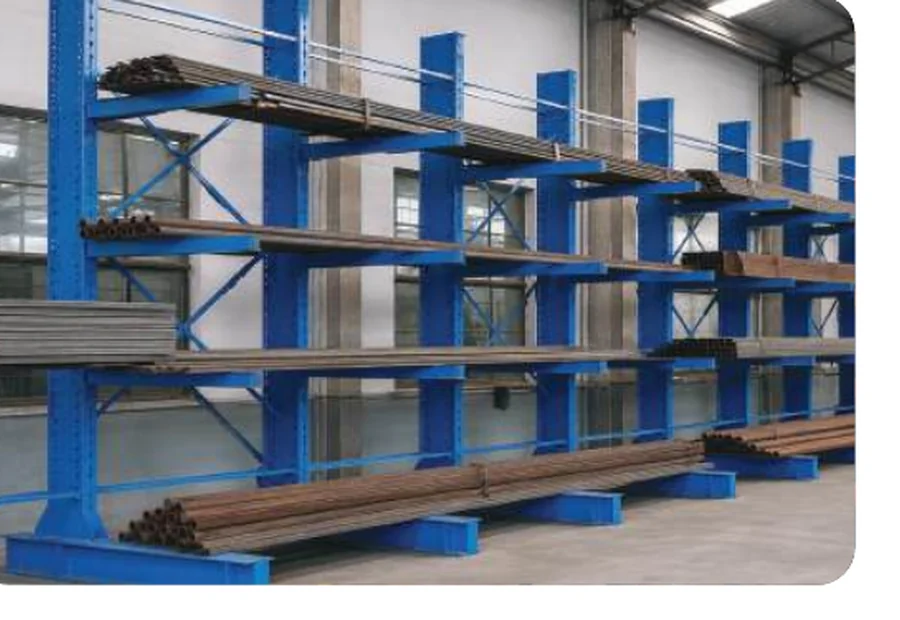
Shrusti Cantilever Racking is a long-load arm racking solution for long, oversized, or bulky items. It provides full arm length, open-fronted with not density-based (length-based) storage density and is planned around manual or lift truck.
DensityNot density-based (length-based)AccessFull arm length, open-frontedHandlingManual or lift truck
Long-load arm racking for long, oversized, or bulky items.
Shrusti Cantilever Racking is designed for long, oversized, or bulky items. Vertical columns carry projecting arms that support pipes, timber, boards, sections and other long items without front uprights obstructing loading. Layouts can be single-sided or double-sided. The system balances not density-based (length-based) storage density with full arm length, open-fronted and uses operator-managed stock flow. Selection starts with the confirmed load unit, inventory profile, available height, floor layout and handling method. Final structural ratings, dimensions and accessories are stated in the Shrusti quotation and approved layout.
How it works
Vertical columns carry projecting arms that support pipes, timber, boards, sections and other long items without front uprights obstructing loading. Layouts can be single-sided or double-sided.
the product profile lists pipes, structural sections, furniture, boards, and wood stocks as typical items stored on cantilever racking, positioning the system for long and oversized or bulky goods generally.
Typical operational scenarios: Best where item length or shape doesn't suit pallet racking or shelving bays.
Industry applications: Steel and pipe distribution, timber and building materials, furniture manufacturing, and general engineering or maintenance stores.
Warehouse use cases
Facilities managing long, oversized, or bulky items.
Layouts requiring full arm length, open-fronted.
Operations using manual or lift truck.
Inventory flows based on operator-managed.
Industry suitability
Cantilever Racking industry suitability
Manufacturing
Strong fitStrong fit where the operation matches this system's documented load, access and inventory profile.
Automotive
Application-dependentApplication-dependent; confirm the load unit, SKU profile, handling method and facility before selection.
Engineering
Strong fitStrong fit where the operation matches this system's documented load, access and inventory profile.
FMCG
Application-dependentApplication-dependent; confirm the load unit, SKU profile, handling method and facility before selection.
Retail
Application-dependentApplication-dependent; confirm the load unit, SKU profile, handling method and facility before selection.
E-Commerce
Application-dependentApplication-dependent; confirm the load unit, SKU profile, handling method and facility before selection.
Pharmaceuticals
Application-dependentApplication-dependent; confirm the load unit, SKU profile, handling method and facility before selection.
Food Processing
Application-dependentApplication-dependent; confirm the load unit, SKU profile, handling method and facility before selection.
Textiles
Application-dependentApplication-dependent; confirm the load unit, SKU profile, handling method and facility before selection.
Chemicals
Application-dependentApplication-dependent; confirm the load unit, SKU profile, handling method and facility before selection.
Logistics & 3PL
Application-dependentApplication-dependent; confirm the load unit, SKU profile, handling method and facility before selection.
Cold Storage
Application-dependentApplication-dependent; confirm the load unit, SKU profile, handling method and facility before selection.
Industrial Distribution
Strong fitStrong fit where the operation matches this system's documented load, access and inventory profile.
Safety, customisation and support
Define the interfaces before installation.
Safety benefits
Confirm arm load and length, column spacing, base stability, end stops, load restraint, handling method and aisle clearance.
Project-specific load ratings and clear operating limits are stated in the approved layout and handover documentation.
Installation planning should separate equipment routes, pedestrian access and service clearances where applicable.
Customization options
Arm length
arm spacing
column height
single/double-sided layout
end stops
decking or special supports.
Installation & support
Storage study and requirement capture
Layout and configuration development
Structural selection and project quotation
Supply and installation coordination
Handover, operator guidance and documentation
AMC, preventive maintenance and inspection support
Maintenance guidance
Inspect arms, column connections, end stops, anchors, bracing and any deformation caused by long-load handling.
Do not modify levels, bays, lanes or platforms beyond the approved configuration without engineering review.
Record impact damage, deformation or missing components and isolate affected positions until reviewed.
Buying guide
Choose from the operating requirement, not the product name.
Who should buy it: Operations with long, oversized, or bulky items.
Access and density: Choose this system when full arm length, open-fronted and not density-based (length-based) density match the operating priority.
Handling equipment: Confirm compatibility with manual or lift truck before fixing aisle, bay or lane dimensions.
Selection criterion: Confirm arm load/length and column spacing.
Expansion: Review the five-year SKU, capacity and building-growth plan before finalising row lengths, levels or platform coverage.
Budget: Commercial pricing is project-specific and follows the approved layout, structural ratings, accessories and installation scope.
Buyers should specify arm length and load rating against their heaviest or longest typical item, decide between single- and double-faced configurations based on aisle access and whether the racking will sit against a wall, and confirm column mounting centre spacing for the load profile with Shrusti's technical team.
Comparison table
Compare adjacent systems.
Attribute
Long Span Shelve Racks
Cantilever Racking
Multi-Tier Cantilever Racking
Storage density
Medium
Not density-based (length-based)
Not density-based
Accessibility
Every shelf position
Full arm length, open-fronted
Ground tier direct; platform via stairs
Load capacity
Project-specific quotation
Project-specific quotation
Project-specific quotation
Cost level
Project-specific quotation
Project-specific quotation
Project-specific quotation
Flexibility
Add-on bays and adjustable beam levels support straightforward extension and reconfiguration.
Columns, arms and row lengths can be extended where foundations and structural ratings allow.
Tier length, arm rows and platform coverage can be extended subject to structural and access review.
Best use case
Wide SKU range, hand-picked
Long, oversized, or bulky items
Long items plus smaller, varied SKUs in one footprint
Warehouse type
Adjustable manual-picking shelving
Long-load arm racking
Multi-level long-load and small-item storage
Ideal industry
General industrial, engineering, and light manufacturing operations with a wide SKU range
Steel and pipe distribution, timber and building materials, furniture manufacturing, and general engineering or maintenance stores
Steel and pipe distribution, timber and building materials, and engineering stores with mixed long-item and small-parts inventory
It stores long, oversized, or irregularly shaped goods — such as pipes, structural sections, timber, and boards — that don't fit the bay geometry of pallet racking or shelving, using arms that project from vertical columns with no front obstruction.
What is the difference between single-faced and double-faced cantilever racking?
Single-faced cantilever racking is loaded from one side only, typically placed against a wall; double-faced racking has arms on both sides of the column and can be loaded and accessed from either side.
Is there a limit to how long cantilever racking can be?
Shrusti states there is no limitation in the length of the cantilever system itself; the practical limit is set by the length and weight of the material being stored, which should be confirmed against arm and column specifications.
Can cantilever racking hold items of different sizes?
Yes — arms are adjustable to accommodate articles of varying heights, and shelves can be added for uneven items or those that vary in dimension.
How is cantilever racking loaded — by hand or forklift?
Both are possible; lighter items can be handled manually, while heavier or bulkier loads are typically placed and removed with a lift truck or other appropriate lifting equipment.
How does cantilever racking differ from multi-tier cantilever racking?
Standard cantilever racking is a single-tier system; multi-tier cantilever racking adds a platform or mezzanine level above the arms, letting a warehouse also store smaller, more varied SKUs on an upper level.
What is Cantilever Racking?
Cantilever Racking is a long-load arm racking system. Vertical columns carry projecting arms that support pipes, timber, boards, sections and other long items without front uprights obstructing loading. Layouts can be single-sided or double-sided.
What inventory profile suits Cantilever Racking?
It is best suited to long, oversized, or bulky items, using pipes, timber, structural sections, boards.
What storage density does Cantilever Racking provide?
The catalogue classifies its storage density as not density-based (length-based). Actual capacity depends on the approved layout and load profile.
How accessible are stored goods in Cantilever Racking?
Storage access is described as full arm length, open-fronted.
What handling equipment is used with Cantilever Racking?
The documented handling method is manual or lift truck. The exact equipment envelope must be checked before the aisle or bay layout is approved.
What stock-rotation method does Cantilever Racking support?
The documented stock-rotation approach is operator-managed.
Universal Shrusti FAQ block
Where is Shrusti based?
Shrusti is based in Chennai, Tamil Nadu, India, and has more than four decades of material-handling and storage-system experience.
Does Shrusti design and install racking systems?
Yes. The project scope can cover requirement study, layout, system selection, supply, installation, handover and ongoing support.
Can a racking layout be customised?
Yes. Bay dimensions, levels, row lengths, access routes, storage method and accessories are selected around the confirmed load, inventory profile and facility.
Is AMC and inspection support available?
AMC, preventive maintenance and rack-inspection support can be included in the commercial scope for the installed system.
What should I share for a quotation?
Share the facility layout, clear height, load dimensions and weight, SKU and pallet profile, required storage capacity, handling equipment and target project timeline.
What is Cantilever Racking, and when should a warehouse use it?
Cantilever racking stores long, oversized, or irregularly shaped goods — such as pipes, timber, structural steel, and boards — on adjustable arms that project from vertical columns, with no front upright to obstruct loading. Warehouses and yards use it wherever material length or shape doesn't suit conventional pallet racking or shelving bays. It's available single-faced (loaded from one side) or double-faced (loaded from both), with adjustable arm heights and column spacing to match different load profiles. It is not the right choice for standard palletised or boxed goods, which conventional racking or shelving handles more efficiently.
Who should choose Cantilever Racking?
Choose Cantilever Racking when the operation has long, oversized, or bulky items and needs full arm length, open-fronted with not density-based (length-based) storage density.
How is Cantilever Racking selected?
Selection begins with the load unit, SKU profile, required positions, building envelope and manual or lift truck. Final dimensions and ratings follow the approved layout.
Is Cantilever Racking a fixed online configuration?
No. Cantilever Racking is a quote-led storage system configured around the facility, load and operating method.
Why choose Shrusti
One accountable path from requirement to operation.
Shrusti has engineered material handling and storage systems from Chennai since 1985. Each racking project starts with the load unit, SKU profile, facility envelope, handling equipment and operating flow, then moves through layout development, structural selection, supply, installation and handover. Customers can also scope site study, commissioning, operator guidance, AMC and lifecycle support through one accountable team.
Request quote
Turn the storage requirement into an approved layout and quotation.