Quote-led storage system • Storage study recommended
Shrusti Drive-In/Drive-Thru Pallet Racking
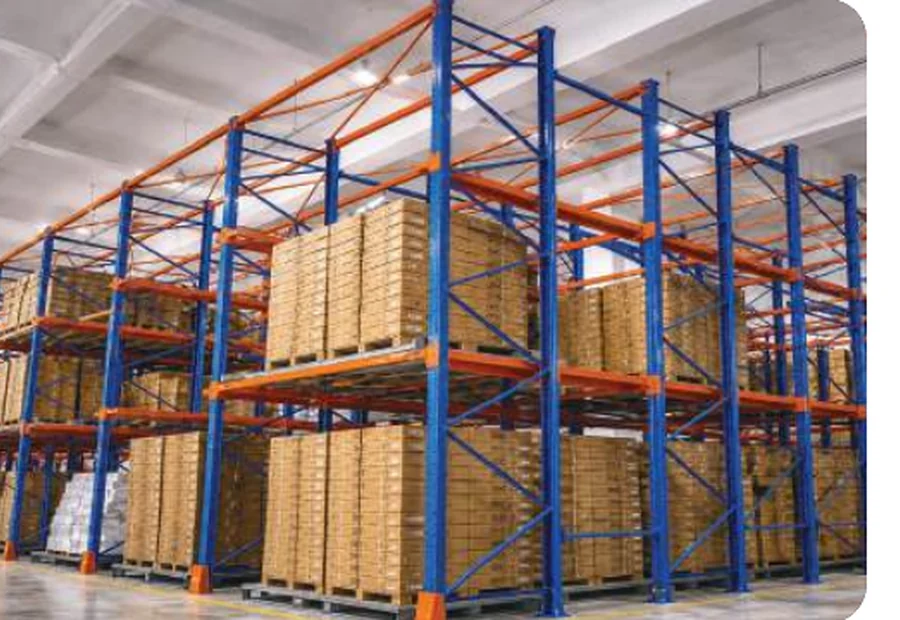
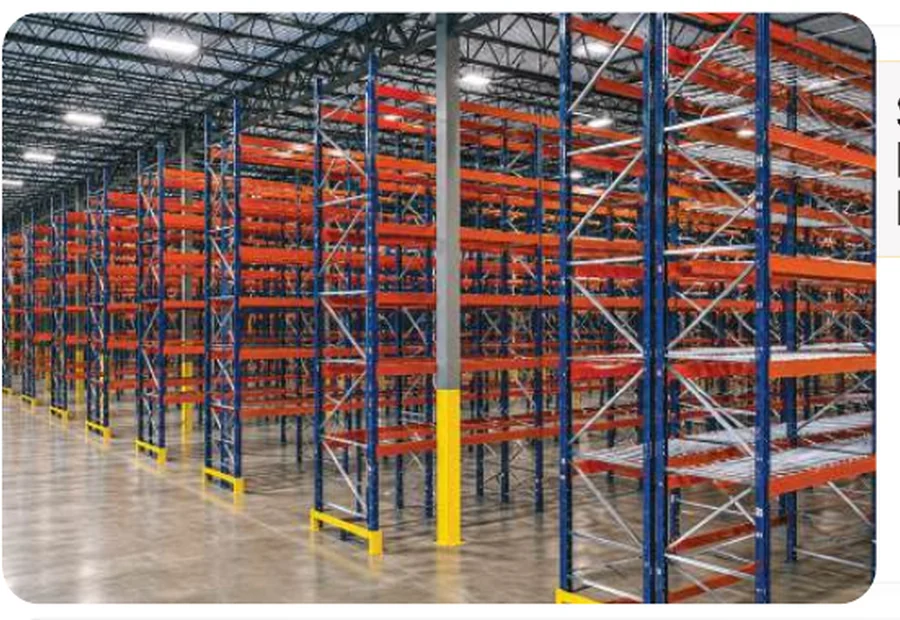
Shrusti Drive-In/Drive-Thru Pallet Racking is a deep-lane pallet storage solution for bulk, low SKU variety, including cold storage. It provides lane-front pallet only with high storage density and is planned around forklift enters the lane.
DensityHighAccessLane-front pallet onlyHandlingForklift enters the lane
Deep-lane pallet storage for bulk, low SKU variety, including cold storage.
Shrusti Drive-In/Drive-Thru Pallet Racking is designed for bulk, low SKU variety, including cold storage. Continuous pallet-support rails form lanes that the forklift enters to place or retrieve loads. Drive-in layouts use one operating face; drive-through layouts provide access from both ends when the building and stock-flow plan permit it. The system balances high storage density with lane-front pallet only and uses not confirmed — top/bottom cycle, limited rotation stock flow. Selection starts with the confirmed load unit, inventory profile, available height, floor layout and handling method. Final structural ratings, dimensions and accessories are stated in the Shrusti quotation and approved layout.
How it works
Continuous pallet-support rails form lanes that the forklift enters to place or retrieve loads. Drive-in layouts use one operating face; drive-through layouts provide access from both ends when the building and stock-flow plan permit it.
Key features
Drive-in or drive-through pallet lanes
Storage density: High
Storage access: Lane-front pallet only
Stock rotation: Rotation method defined by the lane loading and retrieval sequence
Handling method: Forklift enters the lane
Load profile: Homogeneous palletised goods
Additional lanes and levels can be planned where floor area, clear height and forklift manoeuvring allow.
Lift truck enters the rack structure itself along continuous support rails to place and retrieve pallets
Guide rails built into the lane help lift-truck manoeuvring and reduce risk of rack damage
Benefits
Space utilisation: High density for the documented inventory profile.
Accessibility: Lane-front pallet only.
Inventory flow: Rotation method defined by the lane loading and retrieval sequence.
Operational fit: Designed for bulk, low SKU variety, including cold storage.
Handling compatibility: Planned around forklift enters the lane.
Expansion: Additional lanes and levels can be planned where floor area, clear height and forklift manoeuvring allow.
Safety: Use guide rails and clear lane geometry, and verify pallet quality, rail clearances, forklift dimensions, upright protection and lane-loading rules.
Space utilization: Maximises cubic storage density, per Shrusti, by removing the aisle-per-pallet-position requirement of selective racking
Accessibility: Trades individual pallet access for density — only the lane-facing pallet is normally accessible during a given retrieval cycle
Inventory control: Suited to a top-to-bottom or bottom-to-top storage cycle per lane; best matched to single-SKU lanes with limited rotation needs
Technical specifications
Published configuration framework.
Only product information supported by the catalogue is shown. Final dimensions and structural ratings are stated in the approved quotation and layout.
Preferred handling method: Forklift enters the lane.
the product profile identifies FMCG companies, food and spice storage, and cold storage as the primary applications, describing the system as ideal for storing large, heavy volumes of a single SKU with limited stock rotation needs — a good fit for seasonal or bulk goods.
Typical operational scenarios: Best where a small number of SKUs need to be stored in bulk with limited rotation requirements, such as seasonal or high-volume staple goods.
Industry applications: FMCG manufacturing and distribution, food processing, and cold-chain logistics.
Warehouse use cases
Facilities managing bulk, low SKU variety, including cold storage.
Layouts requiring lane-front pallet only.
Operations using forklift enters the lane.
Inventory flows based on not confirmed — top/bottom cycle, limited rotation.
Industry suitability
Drive-In/Drive-Thru Pallet Racking industry suitability
Manufacturing
Strong fitStrong fit where the operation matches this system's documented load, access and inventory profile.
Automotive
Application-dependentApplication-dependent; confirm the load unit, SKU profile, handling method and facility before selection.
Engineering
Application-dependentApplication-dependent; confirm the load unit, SKU profile, handling method and facility before selection.
FMCG
Strong fitStrong fit where the operation matches this system's documented load, access and inventory profile.
Retail
Application-dependentApplication-dependent; confirm the load unit, SKU profile, handling method and facility before selection.
E-Commerce
Application-dependentApplication-dependent; confirm the load unit, SKU profile, handling method and facility before selection.
Pharmaceuticals
Application-dependentApplication-dependent; confirm the load unit, SKU profile, handling method and facility before selection.
Food Processing
Strong fitStrong fit where the operation matches this system's documented load, access and inventory profile.
Textiles
Application-dependentApplication-dependent; confirm the load unit, SKU profile, handling method and facility before selection.
Chemicals
Application-dependentApplication-dependent; confirm the load unit, SKU profile, handling method and facility before selection.
Logistics & 3PL
Strong fitStrong fit where the operation matches this system's documented load, access and inventory profile.
Cold Storage
Strong fitStrong fit where the operation matches this system's documented load, access and inventory profile.
Industrial Distribution
Strong fitStrong fit where the operation matches this system's documented load, access and inventory profile.
Safety, customisation and support
Define the interfaces before installation.
Safety benefits
Use guide rails and clear lane geometry, and verify pallet quality, rail clearances, forklift dimensions, upright protection and lane-loading rules.
Project-specific load ratings and clear operating limits are stated in the approved layout and handover documentation.
Installation planning should separate equipment routes, pedestrian access and service clearances where applicable.
Customization options
Lane depth
number of levels
one- or two-sided access
rail type
guide-rail arrangement and pallet support.
Installation & support
Storage study and requirement capture
Layout and configuration development
Structural selection and project quotation
Supply and installation coordination
Handover, operator guidance and documentation
AMC, preventive maintenance and inspection support
Maintenance guidance
Inspect guide rails, pallet support rails, lane alignment, upright impact, anchors and pallet condition.
Do not modify levels, bays, lanes or platforms beyond the approved configuration without engineering review.
Record impact damage, deformation or missing components and isolate affected positions until reviewed.
Buying guide
Choose from the operating requirement, not the product name.
Who should buy it: Operations with bulk, low SKU variety, including cold storage.
Inventory profile: Homogeneous palletised goods with not confirmed — top/bottom cycle, limited rotation stock flow.
Access and density: Choose this system when lane-front pallet only and high density match the operating priority.
Handling equipment: Confirm compatibility with forklift enters the lane before fixing aisle, bay or lane dimensions.
Selection criterion: Confirm typical/maximum lane depth.
Expansion: Review the five-year SKU, capacity and building-growth plan before finalising row lengths, levels or platform coverage.
Budget: Commercial pricing is project-specific and follows the approved layout, structural ratings, accessories and installation scope.
Buyers should evaluate SKU homogeneity within each lane (drive-in racking works best when a lane holds one SKU at a time), decide between Drive-In (single-entry, generally LIFO) and Drive-Thru (two-entry, can support FIFO) configurations based on their stock-rotation needs, and confirm lift truck compatibility and guide-rail tolerances with Shrusti's technical team.
Comparison table
Compare adjacent systems.
Attribute
Push-Back Pallet Racking
Drive-In/Drive-Thru Pallet Racking
Pallet Live Storage
Storage density
Medium–High
High
High
Accessibility
Lane-front pallet only
Lane-front pallet only
Lane-front pallet only
Load capacity
Project-specific quotation
Project-specific quotation
Project-specific quotation
Cost level
Project-specific quotation
Project-specific quotation
Project-specific quotation
Flexibility
Additional lanes and levels can be added when cart, rail, load and structural ratings are maintained.
Additional lanes and levels can be planned where floor area, clear height and forklift manoeuvring allow.
More lanes and levels can be added where the pallet profile, braking design and structure remain consistent.
Best use case
Moderate SKU variety wanting more density than conventional racking
Bulk, low SKU variety, including cold storage
Rotation-critical, perishable goods
Warehouse type
FILO deep-lane pallet storage
Deep-lane pallet storage
Gravity-fed FIFO pallet storage
Ideal industry
Manufacturing, general stores and distribution, finished-goods storage, and raw material/WIP areas
FMCG manufacturing and distribution, food processing, and cold-chain logistics
Food and beverage, pharmaceuticals, and other operations with date-coded or perishable stock
It is a high-density pallet storage system where the lift truck drives directly into the racking structure along continuous support rails to place or retrieve pallets stacked one behind another in a lane, maximising cubic storage space.
What is the difference between drive-in and drive-thru racking?
Drive-in racking is accessed from one end of the lane only; drive-thru racking is open at both ends, which can support a first-in, first-out rotation pattern rather than the last-in, first-out pattern typical of single-entry drive-in lanes.
What products suit drive-in or drive-thru racking?
Large volumes of a single, homogeneous SKU with limited stock-rotation needs — Shrusti specifically names FMCG, food and spice storage, and cold storage as good fits.
How does drive-in racking affect stock rotation?
Because pallets are stored deep in a lane and generally retrieved on a top-to-bottom or bottom-to-top cycle, stock rotation is more limited than in selective racking, making the system best suited to seasonal or bulk goods rather than fast-moving mixed SKUs.
What forklift equipment does drive-in racking need?
A standard counterbalance lift truck can typically be used, since it is the truck's mast and load — not a specialised attachment — that enters the racking lane; exact clearances should be confirmed against your truck model.
Is drive-in racking suitable for cold storage?
Yes — Shrusti lists cold storage among its recommended applications, since reducing aisle count lowers the refrigerated volume a facility needs to cool.
What is Drive-In/Drive-Thru Pallet Racking?
Drive-In/Drive-Thru Pallet Racking is a deep-lane pallet storage system. Continuous pallet-support rails form lanes that the forklift enters to place or retrieve loads. Drive-in layouts use one operating face; drive-through layouts provide access from both ends when the building and stock-flow plan permit it.
What inventory profile suits Drive-In/Drive-Thru Pallet Racking?
It is best suited to bulk, low SKU variety, including cold storage, using homogeneous palletised goods.
What storage density does Drive-In/Drive-Thru Pallet Racking provide?
The catalogue classifies its storage density as high. Actual capacity depends on the approved layout and load profile.
How accessible are stored goods in Drive-In/Drive-Thru Pallet Racking?
Storage access is described as lane-front pallet only.
What handling equipment is used with Drive-In/Drive-Thru Pallet Racking?
The documented handling method is forklift enters the lane. The exact equipment envelope must be checked before the aisle or bay layout is approved.
What stock-rotation method does Drive-In/Drive-Thru Pallet Racking support?
The documented stock-rotation approach is not confirmed — top/bottom cycle, limited rotation.
Universal Shrusti FAQ block
Where is Shrusti based?
Shrusti is based in Chennai, Tamil Nadu, India, and has more than four decades of material-handling and storage-system experience.
Does Shrusti design and install racking systems?
Yes. The project scope can cover requirement study, layout, system selection, supply, installation, handover and ongoing support.
Can a racking layout be customised?
Yes. Bay dimensions, levels, row lengths, access routes, storage method and accessories are selected around the confirmed load, inventory profile and facility.
Is AMC and inspection support available?
AMC, preventive maintenance and rack-inspection support can be included in the commercial scope for the installed system.
What should I share for a quotation?
Share the facility layout, clear height, load dimensions and weight, SKU and pallet profile, required storage capacity, handling equipment and target project timeline.
What is Drive-In/Drive-Thru Pallet Racking, and when should a warehouse use it?
Drive-in and drive-thru pallet racking is a high-density system where the lift truck enters the racking structure itself, driving above continuous support rails to place or retrieve pallets stacked one behind another along a lane. Warehouses use it to store large volumes of a small number of homogeneous SKUs — common in FMCG, food, and cold storage — where maximising cubic density matters more than accessing every pallet directly. The main consideration is limited stock rotation: only the lane-facing pallet is normally accessible, so it suits bulk or seasonal goods rather than fast-moving, mixed SKUs.
Who should choose Drive-In/Drive-Thru Pallet Racking?
Choose Drive-In/Drive-Thru Pallet Racking when the operation has bulk, low SKU variety, including cold storage and needs lane-front pallet only with high storage density.
How is Drive-In/Drive-Thru Pallet Racking selected?
Selection begins with the load unit, SKU profile, required positions, building envelope and forklift enters the lane. Final dimensions and ratings follow the approved layout.
Is Drive-In/Drive-Thru Pallet Racking a fixed online configuration?
No. Drive-In/Drive-Thru Pallet Racking is a quote-led storage system configured around the facility, load and operating method.
Why choose Shrusti
One accountable path from requirement to operation.
Shrusti has engineered material handling and storage systems from Chennai since 1985. Each racking project starts with the load unit, SKU profile, facility envelope, handling equipment and operating flow, then moves through layout development, structural selection, supply, installation and handover. Customers can also scope site study, commissioning, operator guidance, AMC and lifecycle support through one accountable team.
Request quote
Turn the storage requirement into an approved layout and quotation.