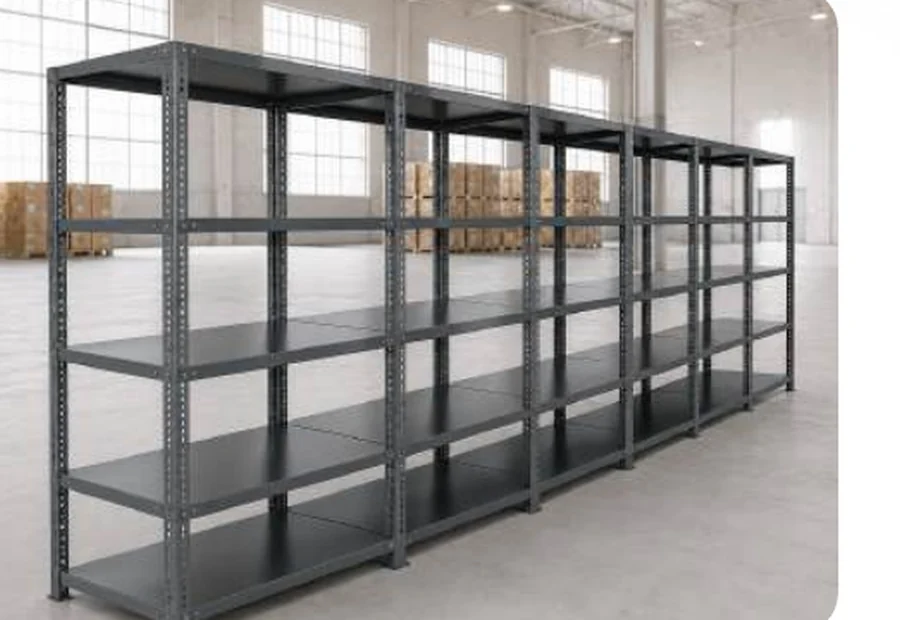
Quote-led storage system • Storage study recommended
Shrusti Mobile Shelving
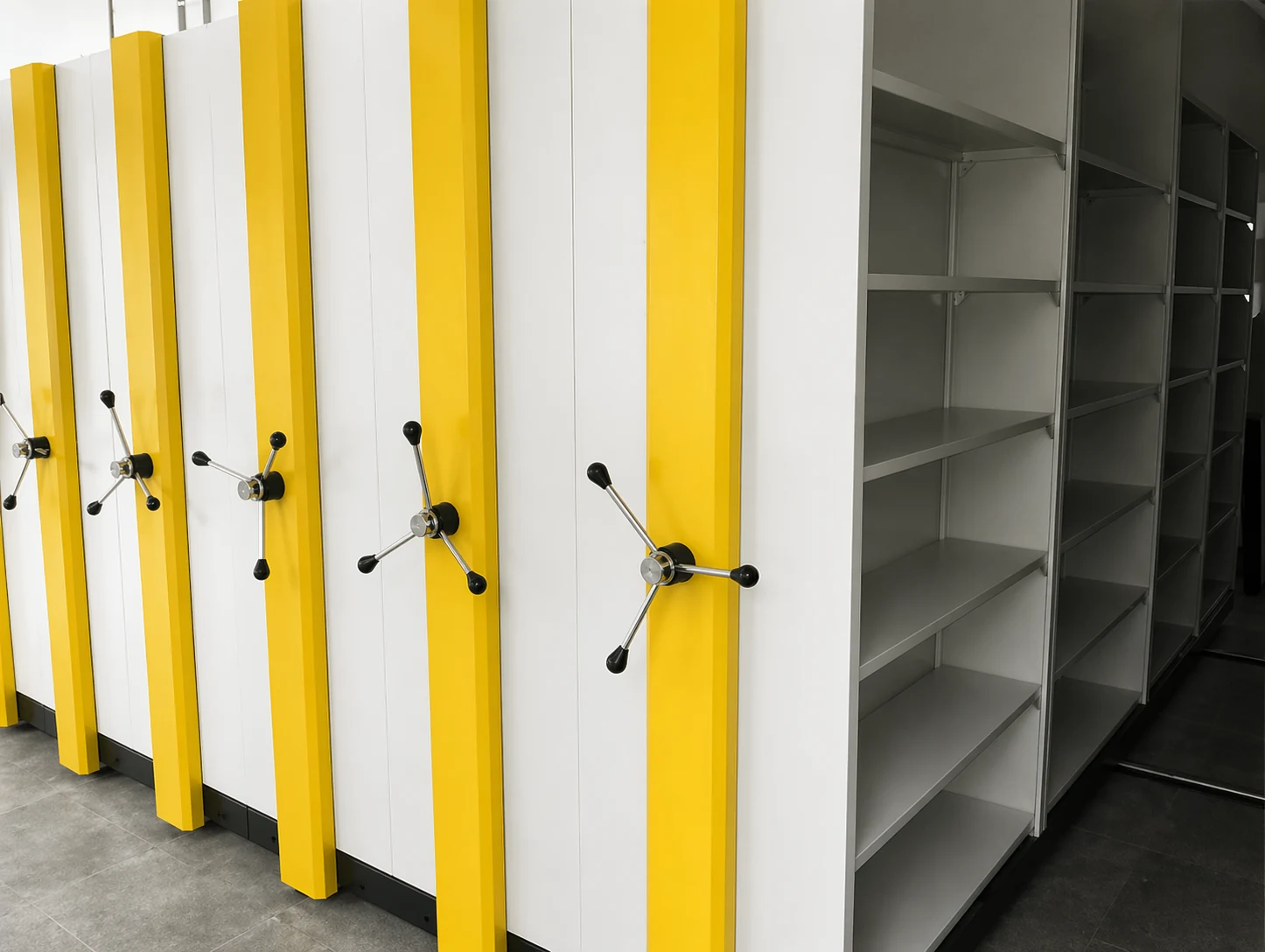
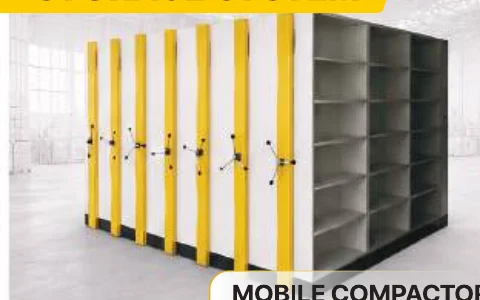
Shrusti Mobile Shelving is a mobile archive and small-parts shelving solution for archives, documents, small parts, space-constrained. It provides every shelf position (one aisle open) with high storage density and is planned around manual (wheel/handle).
DensityHighAccessEvery shelf position (one aisle open)HandlingManual (wheel/handle)
Mobile archive and small-parts shelving for archives, documents, small parts, space-constrained.
Shrusti Mobile Shelving is designed for archives, documents, small parts, space-constrained. Shelving blocks move on mobile bases so only one aisle needs to remain open. Operators turn a wheel or use a handle to open the required aisle and access the selected shelf block. The system balances high storage density with every shelf position (one aisle open) and uses operator-managed stock flow. Selection starts with the confirmed load unit, inventory profile, available height, floor layout and handling method. Final structural ratings, dimensions and accessories are stated in the Shrusti quotation and approved layout.
How it works
Shelving blocks move on mobile bases so only one aisle needs to remain open. Operators turn a wheel or use a handle to open the required aisle and access the selected shelf block.
Key features
Mobile shelving blocks with one working aisle
Storage density: High
Storage access: Every shelf position (one aisle open)
Stock rotation: Operator-managed
Handling method: Manual (wheel/handle)
Load profile: Books, documents, small parts
Additional blocks or shelving modules may be added where rail/base capacity and room dimensions permit.
Shelving or lockers mounted on mobile bases that slide along rails, eliminating all but one working aisle at a time
Stated by Shrusti to double available storage, or reduce the footprint required, versus static shelving
Benefits
Space utilisation: High density for the documented inventory profile.
Accessibility: Every shelf position (one aisle open).
Inventory flow: Operator-managed.
Operational fit: Designed for archives, documents, small parts, space-constrained.
Handling compatibility: Planned around manual (wheel/handle).
Expansion: Additional blocks or shelving modules may be added where rail/base capacity and room dimensions permit.
Safety: Provide stable rails or bases, aisle locking, anti-tip design, controlled movement, clear end stops and secure access where required.
Space utilization: Storage can be doubled, or the required footprint reduced,, by eliminating all but one working aisle
Safety considerations: Security locks on lockers restrict access to authorised personnel.
Product protection: Closed-block arrangement when not in use reduces dust ingress compared with open static shelving.
Technical specifications
Published configuration framework.
Only product information supported by the catalogue is shown. Final dimensions and structural ratings are stated in the approved quotation and layout.
Mobile Shelving technical specifications
Product family
Shelving & Picking
Storage type
Mobile archive and small-parts shelving
Load capacity
Project-specific; final load capacity is stated in the approved structural layout.
Bay configuration
Mobile shelving blocks with one working aisle
Storage depth
Shelf-block depth is project-specific
Frame / structure height
Project-specific; final frame height follows the approved facility layout.
Beam / shelf / tier levels
Shelf levels adjustable at 25 mm intervals.
Shelf-level adjustment
25 mm intervals.
Bay width
Sized to the confirmed load unit and handling method in the approved layout.
Bay depth
Defined by the storage method and load geometry in the approved layout.
Shelf load capacity
Project-specific; no fixed shelf-load figure is published.
Bay load capacity
Project-specific; stated in the approved structural design.
Upright / structural section
Selected to the confirmed load, height and bay arrangement in the structural design.
Material construction
Steel structural components are used; grade and section are confirmed in the technical offer.
Coating / finish
Finish is selected in the quotation for the operating environment.
Storage accessibility
Every shelf position (one aisle open)
Storage density
High
Stock rotation
Operator-managed
Handling method
Manual (wheel/handle)
Expansion capability
Additional blocks or shelving modules may be added where rail/base capacity and room dimensions permit.
Safety provisions
Provide stable rails or bases, aisle locking, anti-tip design, controlled movement, clear end stops and secure access where required.
Suitable load units
Books, documents, small parts
Facility compatibility
Archives, documents, small parts, space-constrained
Customization options
Shelf depth, 25 mm level adjustment, dividers, drawers, doors, locking, labels, handles and block length.
Applications and warehouse use cases
Match the system to the inventory and operating method.
Applications
Primary application: Archives, documents, small parts, space-constrained.
Typical load profile: Books, documents, small parts.
Preferred handling method: Manual (wheel/handle).
the product profile names offices, libraries, publishing houses, and technical archives as core applications, alongside industrial and warehouse use for small articles such as pharmaceutical products or spare parts.
Typical operational scenarios: Best where floor space is limited but a large volume of documents, books, or small components must be kept organised and secure.
Industry applications: Corporate records management, publishing, pharmaceuticals, and general spare-parts warehousing.
Warehouse use cases
Facilities managing archives, documents, small parts, space-constrained.
Layouts requiring every shelf position (one aisle open).
Operations using manual (wheel/handle).
Inventory flows based on operator-managed.
Industry suitability
Mobile Shelving industry suitability
Manufacturing
Application-dependentApplication-dependent; confirm the load unit, SKU profile, handling method and facility before selection.
Automotive
Strong fitStrong fit where the operation matches this system's documented load, access and inventory profile.
Engineering
Application-dependentApplication-dependent; confirm the load unit, SKU profile, handling method and facility before selection.
FMCG
Application-dependentApplication-dependent; confirm the load unit, SKU profile, handling method and facility before selection.
Retail
Application-dependentApplication-dependent; confirm the load unit, SKU profile, handling method and facility before selection.
E-Commerce
Application-dependentApplication-dependent; confirm the load unit, SKU profile, handling method and facility before selection.
Pharmaceuticals
Strong fitStrong fit where the operation matches this system's documented load, access and inventory profile.
Food Processing
Application-dependentApplication-dependent; confirm the load unit, SKU profile, handling method and facility before selection.
Textiles
Application-dependentApplication-dependent; confirm the load unit, SKU profile, handling method and facility before selection.
Chemicals
Application-dependentApplication-dependent; confirm the load unit, SKU profile, handling method and facility before selection.
Logistics & 3PL
Application-dependentApplication-dependent; confirm the load unit, SKU profile, handling method and facility before selection.
Cold Storage
Application-dependentApplication-dependent; confirm the load unit, SKU profile, handling method and facility before selection.
Industrial Distribution
Strong fitStrong fit where the operation matches this system's documented load, access and inventory profile.
Safety, customisation and support
Define the interfaces before installation.
Safety benefits
Provide stable rails or bases, aisle locking, anti-tip design, controlled movement, clear end stops and secure access where required.
Project-specific load ratings and clear operating limits are stated in the approved layout and handover documentation.
Installation planning should separate equipment routes, pedestrian access and service clearances where applicable.
Customization options
Shelf depth
25 mm level adjustment
dividers
drawers
doors
locking
labels
handles and block length.
Installation & support
Storage study and requirement capture
Layout and configuration development
Structural selection and project quotation
Supply and installation coordination
Handover, operator guidance and documentation
AMC, preventive maintenance and inspection support
Maintenance guidance
Inspect rails or running surfaces, wheels, handles, locks, shelf supports, alignment and aisle clearances.
Do not modify levels, bays, lanes or platforms beyond the approved configuration without engineering review.
Record impact damage, deformation or missing components and isolate affected positions until reviewed.
Buying guide
Choose from the operating requirement, not the product name.
Who should buy it: Operations with archives, documents, small parts, space-constrained.
Inventory profile: Books, documents, small parts with operator-managed stock flow.
Access and density: Choose this system when every shelf position (one aisle open) and high density match the operating priority.
Handling equipment: Confirm compatibility with manual (wheel/handle) before fixing aisle, bay or lane dimensions.
Selection criterion: PRIORITY: resolve duplicate content vs Compactors.
Expansion: Review the five-year SKU, capacity and building-growth plan before finalising row lengths, levels or platform coverage.
Budget: Commercial pricing is project-specific and follows the approved layout, structural ratings, accessories and installation scope.
Buyers should confirm whether a hand-cranked or motorised base best suits their usage frequency and floor loading, specify locker or open-shelf configuration based on security needs, and estimate footprint savings against their current static shelving layout with Shrusti's technical team.
Comparison table
Compare adjacent systems.
Attribute
Slotted Angle Racks
Mobile Shelving
Compactors
Storage density
Medium
High
High
Accessibility
Every shelf position
Every shelf position (one aisle open)
Every shelf position (one aisle open)
Load capacity
Project-specific quotation
Project-specific quotation
Project-specific quotation
Cost level
Project-specific quotation
Project-specific quotation
Project-specific quotation
Flexibility
The modular angle-and-shelf construction supports straightforward extensions and level changes.
Additional blocks or shelving modules may be added where rail/base capacity and room dimensions permit.
Additional blocks or internal shelf modules may be introduced where the room and base layout allow.
Best use case
Widely applicable, easily extendable shelving
Archives, documents, small parts, space-constrained
Office/records-room density
Warehouse type
Modular slotted-angle shelving
Mobile archive and small-parts shelving
High-density mobile filing system
Ideal industry
General engineering, light manufacturing, retail, and warehousing
Corporate records management, publishing, pharmaceuticals, and general spare-parts warehousing
Corporate administration, government and institutional records management, and general document-heavy office environments
It is a compact storage system where shelving or lockers are mounted on bases that slide along rails, so only the aisle currently in use needs to stay open, letting the rest of the storage sit closed together as a block.
How much space does mobile shelving save?
Shrusti states that storage can be doubled, or the required footprint reduced, compared with static shelving; actual savings depend on your specific layout.
Is mobile shelving secure?
Yes — lockable locker units are available, restricting access to authorised personnel.
What is mobile shelving typically used for?
Offices, libraries, publishing houses, and technical archives for books and documents, and industrial or warehouse settings for small parts such as pharmaceutical products or spare parts.
Is mobile shelving motorised or hand-operated?
the product profile describes an ergonomic wheel or handle design for shelf-block movement; whether a motorised option is available for this specific product should be confirmed with Shrusti.
How is mobile shelving different from mobile pallet racking?
Mobile shelving is designed for shelf-level items such as documents, books, and small parts on sliding bases; Mobile Pallet Racking applies the same sliding-base principle to full pallet loads in a warehouse setting.
What inventory profile suits Mobile Shelving?
It is best suited to archives, documents, small parts, space-constrained, using books, documents, small parts.
What storage density does Mobile Shelving provide?
The catalogue classifies its storage density as high. Actual capacity depends on the approved layout and load profile.
How accessible are stored goods in Mobile Shelving?
Storage access is described as every shelf position (one aisle open).
What handling equipment is used with Mobile Shelving?
The documented handling method is manual (wheel/handle). The exact equipment envelope must be checked before the aisle or bay layout is approved.
What stock-rotation method does Mobile Shelving support?
The documented stock-rotation approach is operator-managed.
What loads can Mobile Shelving store?
It is intended for books, documents, small parts. Final load ratings and dimensions are confirmed in the Shrusti technical offer.
Universal Shrusti FAQ block
Where is Shrusti based?
Shrusti is based in Chennai, Tamil Nadu, India, and has more than four decades of material-handling and storage-system experience.
Does Shrusti design and install racking systems?
Yes. The project scope can cover requirement study, layout, system selection, supply, installation, handover and ongoing support.
Can a racking layout be customised?
Yes. Bay dimensions, levels, row lengths, access routes, storage method and accessories are selected around the confirmed load, inventory profile and facility.
Is AMC and inspection support available?
AMC, preventive maintenance and rack-inspection support can be included in the commercial scope for the installed system.
What should I share for a quotation?
Share the facility layout, clear height, load dimensions and weight, SKU and pallet profile, required storage capacity, handling equipment and target project timeline.
What is Mobile Shelving, and when should a warehouse use it?
Mobile shelving mounts shelving or lockers on bases that slide along rails, so only one working aisle needs to stay open between units at any time, letting the rest sit closed together as a compact block. Offices, libraries, publishing houses, and technical archives use it to store large volumes of books, documents, or small parts securely without dedicating permanent floor space to an aisle for every row. Shrusti states it can double available storage, or reduce the footprint required, and lockable units add a security option for restricted-access archives.
Who should choose Mobile Shelving?
Choose Mobile Shelving when the operation has archives, documents, small parts, space-constrained and needs every shelf position (one aisle open) with high storage density.
How is Mobile Shelving selected?
Selection begins with the load unit, SKU profile, required positions, building envelope and manual (wheel/handle). Final dimensions and ratings follow the approved layout.
Is Mobile Shelving a fixed online configuration?
No. Mobile Shelving is a quote-led storage system configured around the facility, load and operating method.
Why choose Shrusti
One accountable path from requirement to operation.
Shrusti has engineered material handling and storage systems from Chennai since 1985. Each racking project starts with the load unit, SKU profile, facility envelope, handling equipment and operating flow, then moves through layout development, structural selection, supply, installation and handover. Customers can also scope site study, commissioning, operator guidance, AMC and lifecycle support through one accountable team.
Request quote
Turn the storage requirement into an approved layout and quotation.